
It can be a good time to buy. But only if the home, the price and the full monthly cost work for you.
You do not need to guess the perfect month. You need a home that fits your life, a fair price and a payment you can keep making.
Some homes still get more than one offer. Others sit. Higher loan costs can thin the crowd of buyers, but that does not make every home a bargain.
My advice is simple: find the right home, negotiate with facts and shop for the loan. If the deal does not fit your budget, be ready to walk away.
What sold last month?
Mortgage Expert reviewed Stellar MLS data for September 2026. We looked at homes marked Residential and New Construction = No. We call those resales in this report.
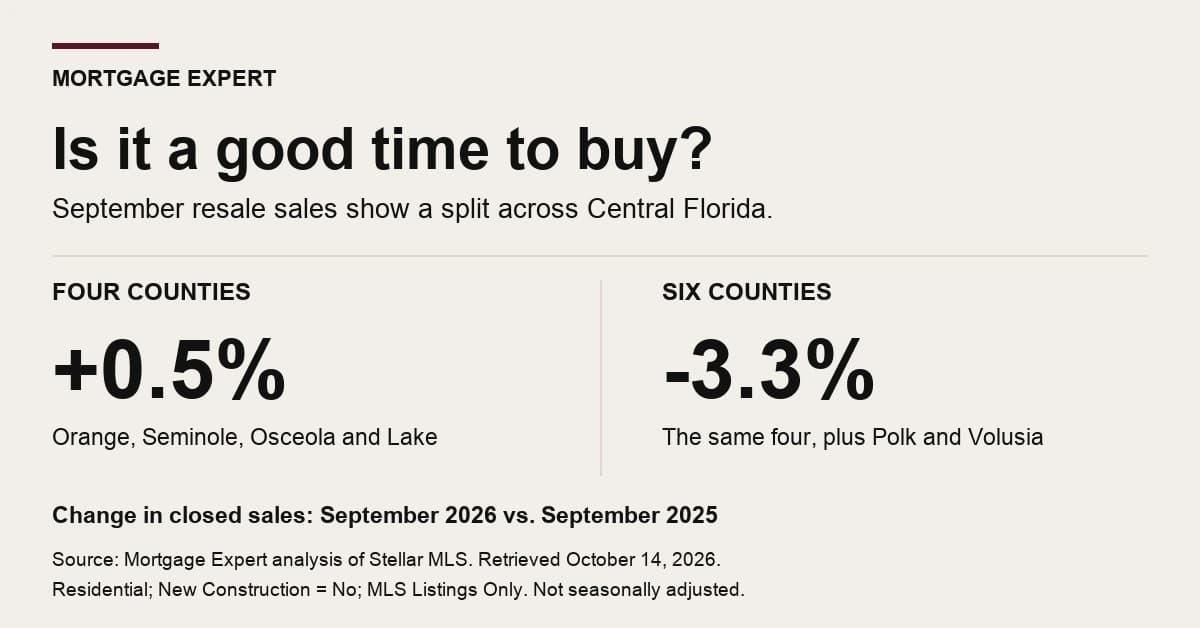
Orange, Seminole, Osceola and Lake counties had 2,430 resale closings. That was 12 more than a year ago, a gain of 0.5%. Sales fell 4.5% from August.
The middle sale price was $389,000. That was 0.7% below September 2025. This is called the median. It marks the middle of the sales when prices are put in order.
The wider six-county picture was softer. With Polk and Volusia added, sales fell 3.3% from a year ago. The middle price held at $360,000.
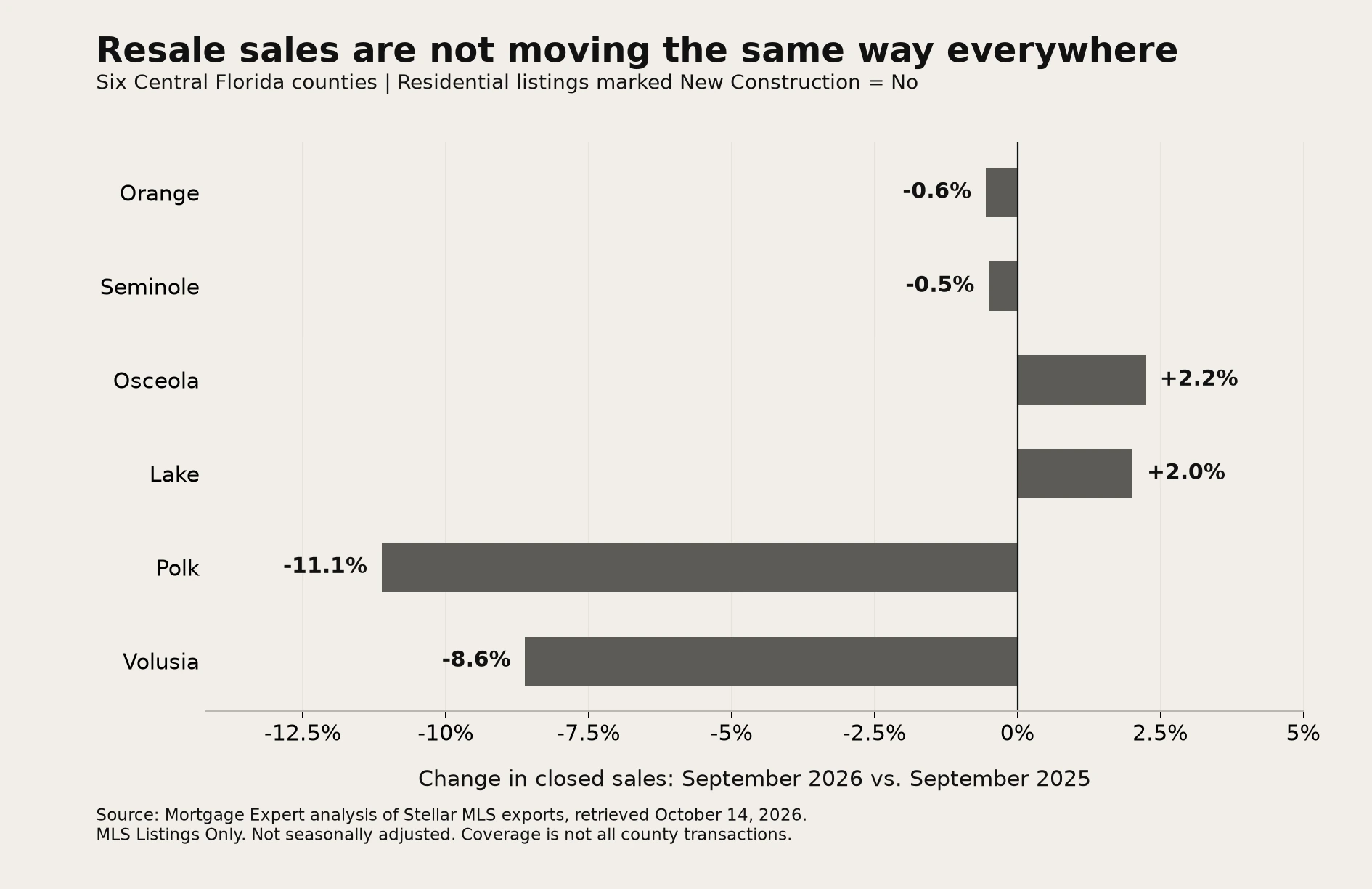
| County | Homes sold | Sales vs. a year ago | Middle sale price | Price vs. a year ago |
|---|---|---|---|---|
| Orange | 1,072 | -0.6% | $424,080 | +1.0% |
| Seminole | 394 | -0.5% | $397,450 | -0.6% |
| Osceola | 457 | +2.2% | $374,900 | +1.3% |
| Lake | 507 | +2.0% | $359,000 | +0.8% |
| Polk | 703 | -11.1% | $300,000 | No change |
| Volusia | 541 | -8.6% | $338,900 | +4.3% |
A county is not one single housing market. A home near the county line can face different demand from one across town. These numbers also reflect which homes sold. They do not prove that the value of each home rose or fell by the same amount.
The kind of home matters, too
In the four-county group, single-family resale sales rose 1.1% from a year ago. Sales of condos and townhouses fell 4.4%.
Their middle sale prices moved too. Single-family homes were down 0.7%, to $435,000. Condos and townhouses were down 1.9%, to $260,000.
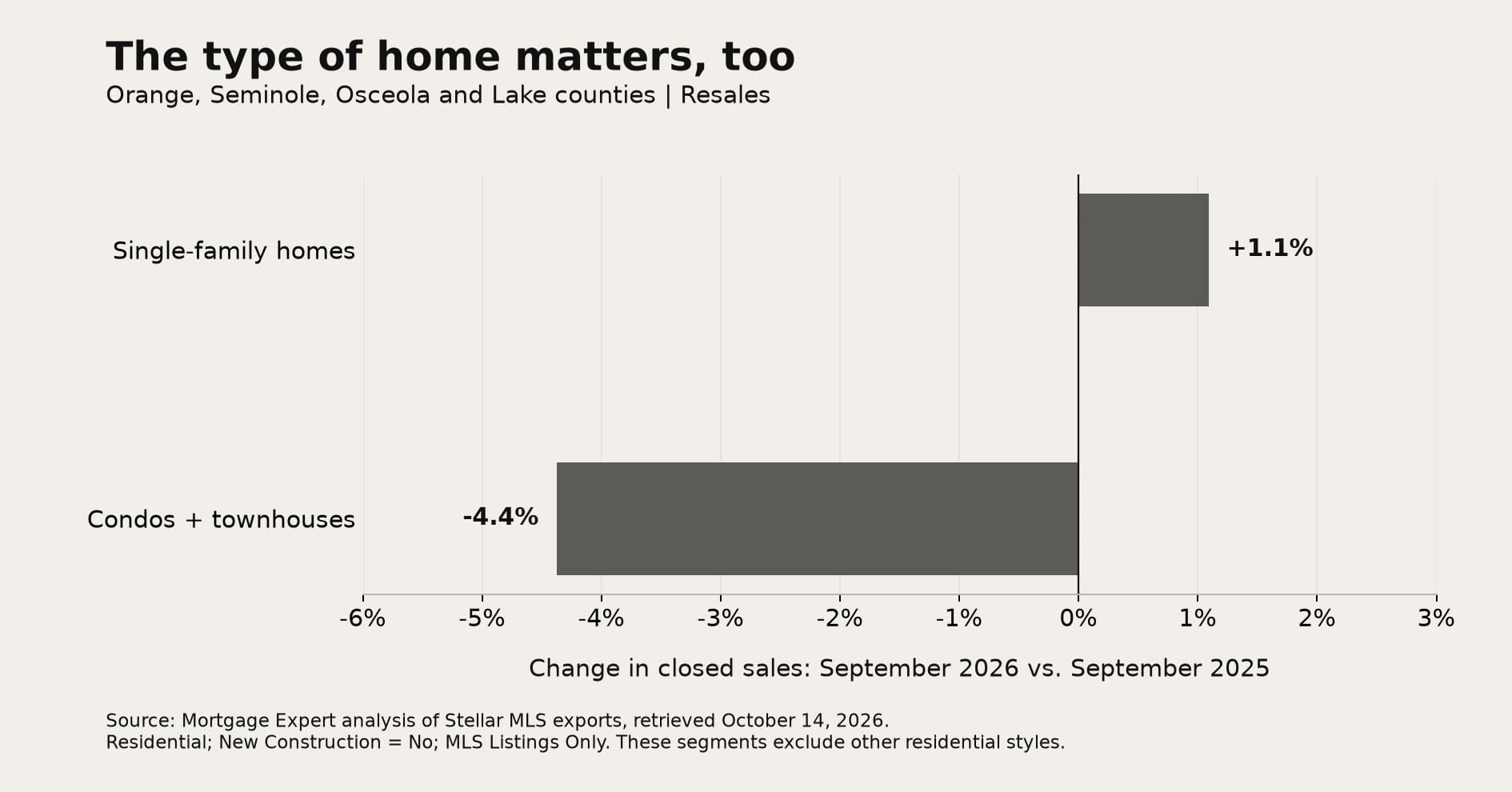
This gives buyers a reason to look closely at the type of home and the area. It is not a reason to assume every condo is a deal or every house will sell fast.
Why do some homes still get several offers?
In my own work, I have seen homes near the middle of the market and homes at higher prices get more than one offer. The homes that stand out tend to be priced well and in good shape.
I have also seen sellers ask for a price based on what a neighbor got two years ago. If the home needs work and the price does not account for that, buyers may pass.
Those are my firsthand observations. Our county report does not count offers or measure how updated each home is.
The lesson for a buyer is to study the home in front of you. Ask your agent for recent sales of similar homes nearby. Compare size, age, condition and location. A sale from two years ago is not enough on its own.
For sellers, updates do not excuse any asking price. A clean, well-kept home still needs a price that makes sense now.
Why does inflation affect your mortgage?
Inflation means the price of goods and services is rising. On October 14, the U.S. Bureau of Labor Statistics reported that consumer prices rose 0.6% in September, after seasonal adjustment. Prices were 3.7% higher than a year earlier, before that adjustment. Source: BLS
When inflation stays high, investors may want a higher return on bonds. Bonds tied to home loans help shape mortgage pricing. When their prices fall, a lender may raise its rate, charge more upfront for the same rate or offer less credit toward costs.
That does not mean every lender changes by the same amount. It also does not mean a Federal Reserve decision and a mortgage rate always move together.
For a buyer, the practical issue is simple: a home with the same price can cost more each month when the loan gets more costly.
The October 14 news cannot explain sales that closed in September. September buyers often agreed to buy weeks before closing.
Are fewer people applying for home loans?
The Mortgage Bankers Association's October 14 report said mortgage rates rose in the prior week and showed weaker demand for purchase loans nationwide. For the week ending October 9, its purchase index fell 4% after seasonal adjustment. Without that adjustment, purchase applications were 16% below a year earlier. Source: MBA
That is a signal of softer demand from people who need a loan. It is not a count of every person looking at homes or proof of a local drop in demand. Cash buyers do not need a mortgage. One buyer may apply with more than one lender. National data also cannot tell us how many offers a home in Orlando will get.
Does 4.9 months of supply mean a crash is coming?
No. It also does not prove that prices cannot fall.
ORRA reported 4.9 months of supply for August 2026. That is an August figure from ORRA's reporting area, not a September result from our four-county study. Source: ORRA
Months of supply asks a simple question: how long would the homes for sale last at the current sales pace, if no more came on the market?
Six months is often used as a rough sign of balance between buyers and sellers. It is not a crash switch. Prices can fall with less supply, and more supply does not guarantee a crash. Jobs, loan costs, household budgets and the need to sell matter too.
Our September figures show a mixed market. They do not show a broad collapse across all six counties. They also cannot promise what prices will do next.
A simple plan before you make an offer
- Set a full budget. Include the loan payment, taxes, insurance, HOA or condo fees, repairs and cash left for emergencies. For a condo, check dues and any special assessments.
- Check the home and the price. Review recent nearby sales and get the inspections you need. A low price may come with costly repairs.
- Ask what can be negotiated. Price, repairs or seller-paid closing costs may be options. Seller credits depend on the loan's rules and the deal. They are not guaranteed.
- Compare matching loans. Ask lenders to quote the same loan type, amount, down payment and lock period, as close together in time as possible. Compare the rate, APR, fees, points, payment and cash needed to close. The CFPB recommends comparing Loan Estimates from multiple lenders. Source: CFPB
- Make sure the payment works now. Do not buy only because you hope to refinance later. A lower future rate is not promised, and a refinance has costs and approval rules.
Think of shopping for the same Toyota at two dealers. You need to match the model and features, then compare the total price. For a mortgage, also weigh service, your ability to qualify and whether the lender can meet the closing date.
You can start with the Mortgage Expert rate calculator, then ask for Loan Estimates based on your own situation. A calculator is a planning tool, not a loan approval, commitment to lend, rate lock or official Loan Estimate. Mortgage Expert does not claim the best rate for every borrower.
For a closer look at upfront loan costs, read our guide to paying mortgage points.
A good time to buy is when the right home and a sound budget meet. Take the time to check both.
About the data
Mortgage Expert analyzed Stellar MLS Matrix exports retrieved October 14, 2026. The monthly comparison covers September 2025 through September 2026. Filters: Residential; Florida; the named counties; New Construction = No; MLS Listings Only; test records and records marked Exclude From Inventory Stats excluded. No agent-association filter was used. The four-county group is Orange, Seminole, Osceola and Lake; the six-county group adds Polk and Volusia. Neither is labeled an official ORRA or MSA series.
“Resale” depends on the listing's New Construction field. These records do not capture every real estate transaction. Sold-data-entry-only records are excluded. Figures can change with late reports and corrections. Counts are not seasonally adjusted. Regional medians were exported directly, not averaged from county medians. Condo/townhouse and single-family groups do not cover all residential styles.
NAR published its September national report on October 13. This article offers an independent local breakdown, not a claim to be the first September housing report. NAR release
Start with a loan comparison
Explore estimates, then compare Loan Estimates for the same loan and your own situation. No name, email, phone number or credit pull is required to use the calculator.